Guide · Conferences
How to run a corporate conference and time the agenda
Decide the one message you want people to leave with, then build the day around it. Put the strategic content in the morning, write every transition into the agenda, and agree with each speaker how they will be brought to a close. Do this six to eight weeks ahead and the day runs itself.
By Naïm Terrache, event host · Updated
What do I decide first when running a corporate event?
Three things: what leadership wants people to remember, who is in the room, and how much time you have. Staff, clients and partners need different tones and different agendas.
Also write down the language the audience actually speaks. It is not always the language of the program, and it is the detail teams most often forget.
How do I time a conference agenda?
Time the transitions, not only the talks. A change of speaker takes at least a minute: standing up, walking to the stage, settling in, checking the microphone. Across a day with twenty speakers, those minutes decide whether the afternoon break survives.
Put the strategic content in the morning and never straight after lunch, which is the low point of the day. Give every break a written restart time. A break with no restart time grows.
How do I keep speakers to time?
Agree it with each speaker before the day: how long they have, how they will be signaled, and how the host will close them. A speaker who has agreed to be wrapped up accepts it on stage. A speaker who has not agreed will not, and nobody in the room will want to be the one to say so.
Mark two or three segments that can be shortened if the day runs late, such as a video, a question session or a break. That is where you recover time, without telling the audience.
Who should hold the microphone?
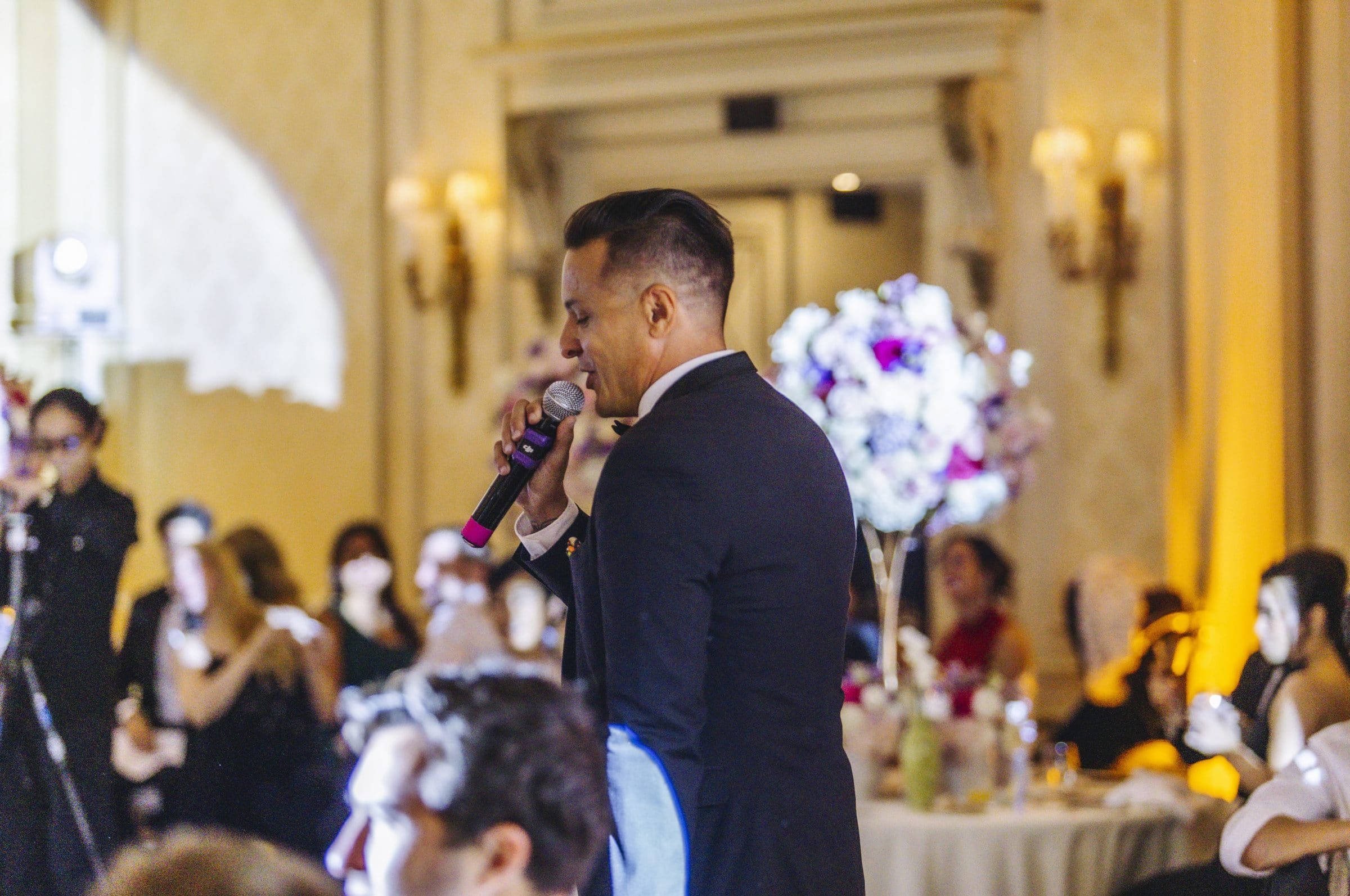
For a one-hour internal meeting, a senior manager is enough. Once the event runs a full day, has many speakers, or includes clients or an international audience, an outside host makes the difference. An employee finds it hard to cut off a director who is overrunning. An outside host can do it without a hierarchy problem.
The host does not replace the producer. The program and the decisions stay with you.
How far ahead should I book the host?
Six to eight weeks before the event leaves room to build the running order, review it with you and absorb late changes. Under three weeks, writing and review get compressed. The busiest months are January, June, November and December.
I write the running order with your producer from your program, even a provisional one, and I rehearse with your technical crew before the doors open.
Questions
- How long should a conference session be?
- There is no fixed figure. What matters is that every session has a written duration and that one person has the authority to enforce it.
- Do I need a host for a conference of 100 people?
- Not always. For a half day with few speakers, a confident manager can do it. For a full day, with clients or several languages, a host is worth having.
- What do I do when a speaker overruns?
- Agree a signal and a way to close with the speaker before the event. The host applies it. Without that agreement, nobody wants to do it live.
- Do I need a rehearsal?
- For a simple talk, a thirty-minute check with the technical team before the doors open is enough. When there are videos, music and entrances, rehearse on site.
Services this applies to
Other guides
- What does an event host do?
- What decides the cost of a corporate emcee
- How to find and book an event host
- Emcee or moderator: which do you need?
- Questions to ask an emcee before you book
- How to write a run of show for your emcee
- Finding an English-speaking event host in France
- Bilingual emcee or interpreter: which one does your event need?
- Bringing a gala to France: what actually changes
- How to script and time an awards evening
- When a speaker overruns: what the host does
- What a host does at a product launch
- How to introduce a keynote speaker
- How to run an audience Q&A at a conference
- What is a compere? Compere, emcee, MC and host compared
- How announcements between acts keep a live show continuous
- Hosting an event that is also filmed or streamed: what changes
- How to judge an event host’s preparation before you book
- Colleague, professional or guest: who runs the programme?
- What a stage host does at a trade show or multi-stage event
 Photo : @selim_mahieu
Availability
Get a quote for your event.
Send the date, the city, the format and the languages of your audience. You get availability and a quote back, usually within the day.